
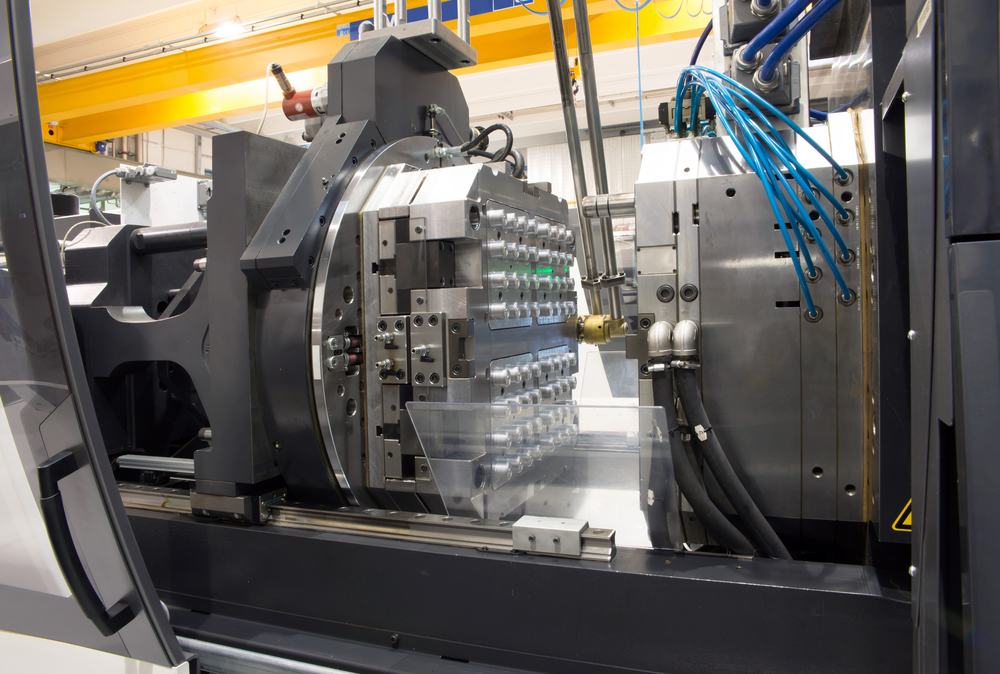
What is Injection Moulding?
Injection moulding is a manufacturing process used to produce parts by injecting molten material – usually plastic – into a mould. Once cooled, the material solidifies into the shape of the mould cavity. This method is favoured for its ability to produce high volumes of identical, complex parts with exceptional precision and repeatability.
For inventors, startups, and companies designing their own products, injection moulding is often the bridge between prototype and mass production. It’s cost-effective for large runs, offers a wide range of material options, and can accommodate intricate designs that would be difficult or impossible to achieve with other methods.
How Does Injection Moulding Work?
Imagine injection moulding as a high-tech way of making plastic parts, like filling an ice cube tray, but with molten plastic and a lot more precision. Here’s what happens in simple terms
1. The Mould Closes
A custom-made mould (think of it as a super-precise metal “ice cube tray”) is clamped shut inside a machine. This mould is shaped exactly like the part you want to create, whether it’s a toy, a car component, or a phone case. The machine holds it tightly closed so nothing leaks out when the plastic is injected.
2. Plastic is Melted and Injected
Tiny plastic pellets (like small grains of rice) are fed into a heated barrel, where they melt into a liquid. This molten plastic is then pushed – under high pressure – into the empty mould, filling every nook and cranny of its shape. Think of it like squeezing toothpaste into a tight space, but with much more force and control.
3. The Plastic Cools and Hardens
Once the mould is filled, the plastic starts to cool down and solidify, taking on the exact shape of the mould. The cooling time depends on the type of plastic and how thick your part is. For example, thin parts (like a bottle cap) cool almost instantly, while thicker parts (like a car bumper) take a little longer.
4. The Part is Ejected
After the plastic has fully hardened, the mould opens, and the finished part is gently pushed out, ready to use. Any extra plastic (like the bits left in the channels) is trimmed off and often recycled for the next batch.
Why This Matters for You
- Speed: This process is fast—some parts take just seconds to make, which is why it’s great for mass production.
- Precision: The mould captures even the finest details, so your design comes out exactly as you imagined.
- Versatility: By changing the mould, you can create almost any shape, from tiny gears to large panels.
No need to worry too much about the technical details, LBFG’s engineers handle everything, from designing the mould to fine-tuning the process for your specific part. You just provide the idea, and we take care of the rest!
Common Injection Moulding Materials
Choosing the right material is critical for product performance, cost, and manufacturability. Here’s a quick guide to the materials LBFG most commonly works with:
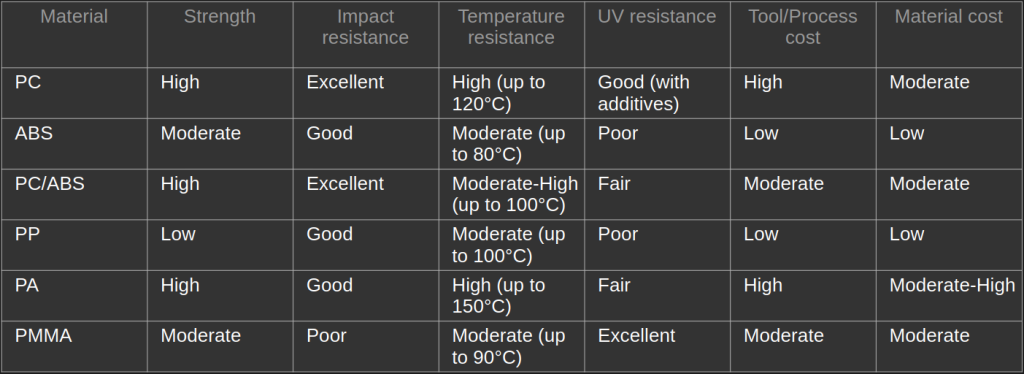
Chart: Key properties and uses of PC, ABS-PC, ABS, PMMA, PP, and PA.
- PC (Polycarbonate): Strong, impact-resistant, and transparent. Ideal for automotive components, medical devices, and electronic housings.
- ABS-PC (ABS/Polycarbonate Blend): Combines the strength of PC with the flexibility of ABS. Used in automotive interiors and consumer electronics.
- ABS (Acrylonitrile Butadiene Styrene): Tough, lightweight, and easy to mould. Common in toys, appliances, and prototyping.
- PMMA (Poly Methyl MetAcrylate): Known for optical clarity and weather resistance. Used in signage, lighting, and display screens.
- PP (Polypropylene): Chemical-resistant and flexible. Found in packaging, textiles, and reusable containers.
- PA (Polyamide/Nylon): High strength, abrasion resistance, and thermal stability. Used in gears, bearings, and mechanical parts.
LBFG also has experience with fibre-reinforced materials, which offer enhanced strength and stiffness for demanding applications.
Why Choose Injection Moulding?
1. Scalability
Injection moulding is unmatched for high-volume production. Once the mould is made, each additional part costs very little, making it ideal for mass production.
2. Precision & Complexity
The process can produce intricate shapes, thin walls, and fine details that are difficult to achieve with other methods.
3. Material Versatility
From rigid plastics to flexible elastomers, injection moulding supports a vast range of materials, each with unique properties.
4. Efficiency & Waste Reduction
Modern injection moulding is highly efficient, with minimal material waste. Scrap plastic can often be reground and reused.
Trends Shaping Injection Moulding in 2026
- Automation & AI: Smart factories use AI to monitor and optimise the moulding process in real time, reducing defects and downtime.
- Sustainability: There’s a growing demand for recycled and bio-based materials, as well as energy-efficient machines.
- Hybrid Manufacturing: Combining 3D printing with injection moulding (as LBFG does) allows for rapid prototyping and tooling, speeding up product development.
- Localised Production: More companies are choosing UK and European suppliers to reduce supply chain risks and improve quality control.
LBFG’s Approach: Your Single Point of Contact
At LBFG, we understand that navigating the transition from prototype to mass production can be overwhelming. That’s why we offer a one-stop solution: you work with a single point of contact for everything—design reviews, supplier coordination, paperwork, and invoicing. We manage the entire process, from the initial “napkin sketch” to final production, whether your moulds are made in the UK, Europe, Taiwan, or China.
Our in-house engineers have decades of experience bringing over 250 tools to production, ensuring your project is in expert hands. We specialise in hybrid solutions, combining 3D printing for prototyping and rapid tooling with traditional injection moulding for scalable production. And with our network of trusted partners, we can handle multicolour and multimaterial moulds, giving your product a competitive edge.
Next Steps
Ready to bring your product to life? Contact LBFG today to discuss how we can streamline your journey from design to mass production.