
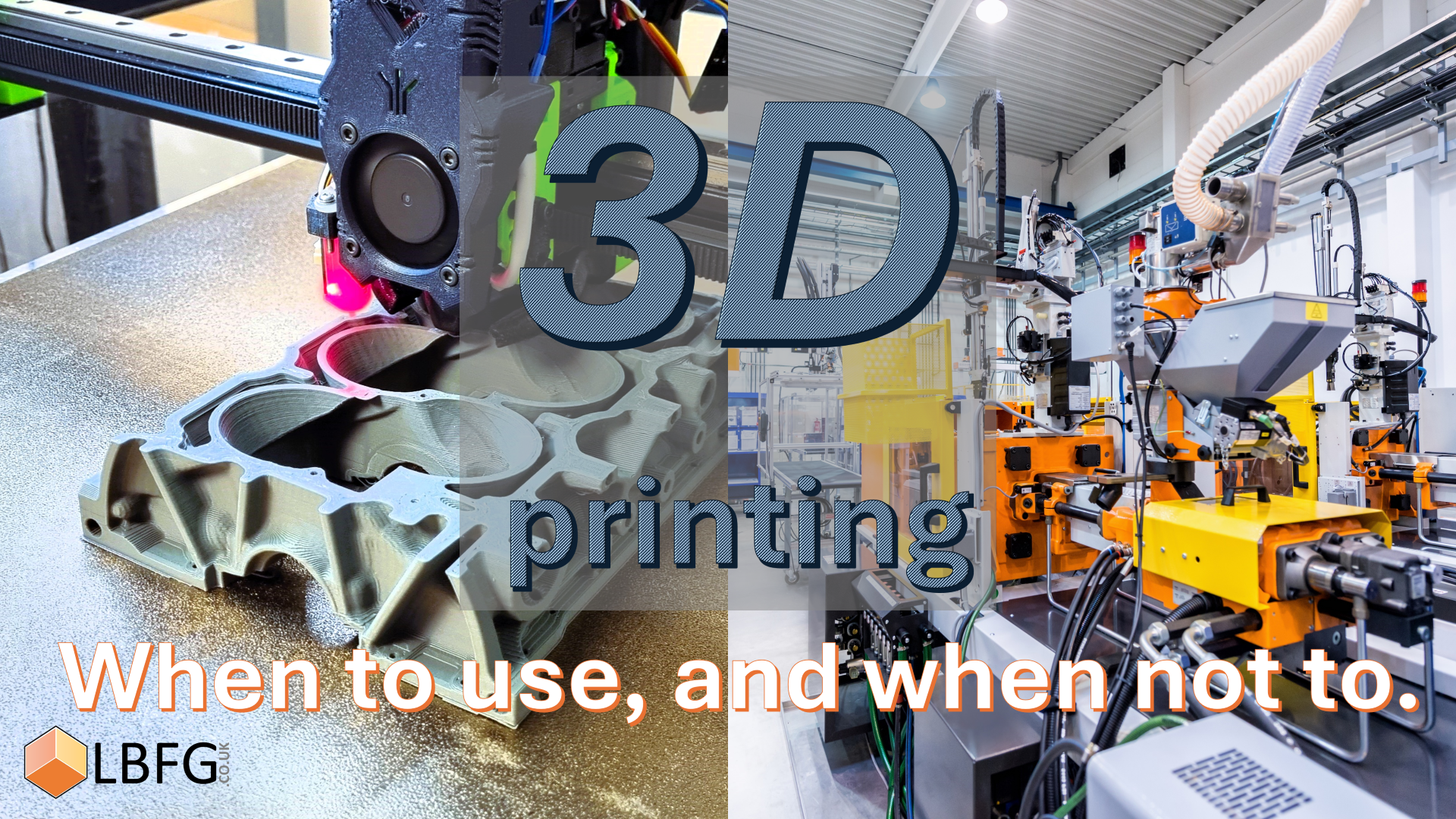
Exploring the pros and cons.
3D printing has become a game-changer in the world of manufacturing, prototyping, and design, but it’s not a one-size-fits-all solution. While it offers incredible flexibility, rapid production, and customisation, there are still scenarios where other manufacturing methods might be more appropriate. In this blog post, we’ll dive into when you should embrace 3D printing and when it might be better to consider alternative manufacturing processes.
When you should use 3D printing
- Prototyping & Product Development
- Speed and Efficiency: If you’re in the early stages of product development and need a prototype quickly, 3D printing is an excellent choice. The ability to quickly turn digital designs into physical objects allows you to test concepts, evaluate functionality, and iterate on designs without waiting weeks for traditional manufacturing processes.
- Low-Cost Prototyping: For single prototypes or low-volume iterations, 3D printing is often much more affordable than other methods. You can test and refine your design before committing to costly moulds or tooling.
- Low Volume Production
- Custom and Short Runs: For small-batch production or highly customised parts, 3D printing offers an ideal solution. Traditional manufacturing methods like injection moulding require expensive moulds, making them cost-prohibitive for runs of fewer than a thousand units. 3D printing, on the other hand, is cost-effective for small-scale production, whether you need a few units or several hundred.
- On-Demand Manufacturing: 3D printing allows businesses to produce parts on demand. This is particularly useful if you want to avoid warehousing costs and the risks of overproduction.
- Complex Geometries
- Design Freedom: If your product design involves intricate details, internal cavities, or complex geometries that would be difficult or impossible to achieve with traditional manufacturing methods, 3D printing is a perfect fit. This technology can create intricate shapes in one go, eliminating the need for assembly or specialised tooling.
- Lightweight Components: For industries like aerospace, automotive, and even medical devices, 3D printing can help create lightweight structures, such as lattice designs or thin walls, that would be challenging to produce with CNC machining or casting.
- Customisation
- Personalised Products: Whether it’s custom-fit medical devices like hearing aids, dental aligners, or unique consumer products, 3D printing allows for complete customisation without additional costs. Traditional methods often require retooling for customisation, which is costly and time-consuming, but with 3D printing, each part can be unique at no extra cost.
- Mass Customisation: Industries like fashion, eyewear, and electronics are increasingly turning to 3D printing to offer mass-customised products tailored to individual consumers, something traditional manufacturing can’t do efficiently.
- Rapid Iteration and Design Flexibility
- Design Changes on the Fly: With 3D printing, it’s easy to tweak and modify your design without significant downtime. This is particularly useful when refining prototypes or when you’re looking to quickly respond to market trends and customer feedback. The design-to-production timeline can be shortened dramatically, enabling rapid iteration.
- Reduced Lead Times: Because there’s no need to create moulds or tooling, 3D printing can drastically reduce lead times for parts, especially during the design phase.
- Sustainability
- Material Efficiency: Unlike traditional manufacturing processes that are often subtractive (e.g., CNC machining), 3D printing is additive, meaning it only uses the material needed to build the part. This results in less waste.
- Localized Production: 3D printing can be done locally, reducing the need for long-distance shipping and minimising the carbon footprint. This is particularly advantageous for businesses looking to operate in a more environmentally friendly way.
When you should not use 3D Printing
- High Volume Production
- Cost per Unit: While 3D printing excels in low-volume production, it can become prohibitively expensive for large-scale manufacturing. Traditional methods like injection moulding, once the mould is created, offer much lower costs per unit when producing thousands or millions of parts. If you’re looking for mass production, injection moulding, die casting, or stamping are likely better options.
- Cycle Time: In high-volume manufacturing, traditional methods can produce thousands of units per day. 3D printing, depending on the technology, can be much slower and may not meet the demand for high-throughput production.
- Limited Materials Options
- Material Properties: While the range of materials available for 3D printing has grown significantly, it still lags behind traditional manufacturing in terms of material diversity, especially for high-performance materials. If your project requires materials with specific mechanical properties, like certain metals or heat-resistant plastics, traditional manufacturing might be the only option.
- Durability: Some 3D printing materials, particularly for consumer-grade printers, may not offer the same durability or resistance to environmental factors as materials used in traditional manufacturing methods.
- Surface Finish and Precision
- Post-Processing Requirements: Most 3D printed parts, especially those produced by FDM (Fused Deposition Modelling) or SLS (Selective Laser Sintering), require some degree of post-processing to achieve a smooth surface finish or higher precision. In contrast, methods like injection moulding can produce parts with smooth finishes right off the bat. If you need a high-quality finish without significant post-processing, traditional methods may be a better fit.
- Tolerances: While some 3D printing technologies, such as SLA (Stereolithography) and DLP (Digital Light Processing), offer excellent precision, they still can’t always match the tight tolerances achievable by CNC machining or injection moulding. For highly precise parts, especially in industries like aerospace or automotive, traditional manufacturing may be more reliable.
- Strength and Durability
- Post-Processing Requirements: Most 3D printed parts, especially those produced by FDM (Fused Deposition Modeling) or SLS (Selective Laser Sintering), require some degree of post-processing to achieve a smooth surface finish or higher precision. In contrast, methods like injection moulding can produce parts with smooth finishes right off the bat. If you need a high-quality finish without significant post-processing, traditional methods may be a better fit.
- Tolerances: While some 3D printing technologies, such as SLA (Stereolithography) and DLP (Digital Light Processing), offer excellent precision, they still can’t always match the tight tolerances achievable by CNC machining or injection moulding. For highly precise parts, especially in industries like aerospace or automotive, traditional manufacturing may be more reliable.
- Strength and Durability
- Load-Bearing Parts: If your product needs to bear heavy loads or operate under extreme stress, some 3D printing materials may not offer the strength required, particularly with consumer-grade printers. While there are high-performance 3D printing materials, such as carbon fiber composites, traditional materials like steel or aluminium produced through CNC machining or metal casting are often better suited for heavy-duty applications.
- Layer Adhesion: Many 3D printing processes build objects layer by layer, which can result in weak points where the layers bond. This isn’t a concern with methods like injection moulding, where the material is formed as one solid piece. For applications where part strength is critical, 3D printing may not be the best choice.
- Complex Assembly or Multi-Part Products
- Component Integration: If your product involves multiple parts that need to fit or move together, traditional manufacturing methods may be better suited. Injection moulding, for instance, allows for over-moulding or insert moulding, creating parts that are already integrated or bonded in ways that 3D printing may not be able to replicate easily.
- Material Combination: Some products require parts made from multiple materials with different properties. While multi-material 3D printers exist, they are often limited in scope and much more expensive. In cases where multiple materials are essential, traditional methods might be more suitable.
Weighing your options
3D printing is a powerful tool in the modern manufacturing landscape, but it’s essential to know when it’s the right fit for your project. It excels in prototyping, small to medium batch production, complex designs, and customisation, making it a top choice for start-ups, designers, and innovators. However, for high-volume production, precise tolerances, or when specialised material are required, traditional manufacturing methods like injection moulding, CNC machining, or casting might be more appropriate.
If you’re unsure which method is best for your project, consult with a knowledgeable manufacturing partner who can help guide you through the decision-making process. By understanding the strengths and limitations of 3D printing, you can make informed choices that lead to successful, cost-effective products.